Alexander Balas
Alexander Balas
Jump to navigation
Jump to search
| Alexander I Balas | |
|---|---|
 | |
King of the Seleucid Empire (King of Syria) | |
| Reign | 150/Summer 152 – August 146 BC |
| Predecessor | Demetrius I Soter |
| Successors | Demetrius II Nicator or Antiochus VI Dionysus |
| Born | Smyrna |
| Died | August 146 BC |
| Spouse | Cleopatra Thea |
| Issue | Antiochus VI Dionysus (first son with Cleopatra Thea) |
| Dynasty | Seleucid |
| Father | Antiochus IV Epiphanes (unconfirmed) |
| Mother | Laodice IV (unconfirmed) |
Alexander I Theopator Euergetes, surnamed Balas (Ancient Greek: Ἀλέξανδρoς Bάλας), was the ruler of the Greek Seleucid kingdom in 150/Summer 152 – August 146 BC.[1] Alexander defeated Demetrius Soter for the crown in 150 BC. Ruling briefly, he lost the crown to Demetrius II Nicator during his defeat at the Battle of Antioch (145 BC) in Syria, dying shortly after.
He is the title character of the oratorio Alexander Balus, written in 1747 by George Frideric Handel.
Contents
1 Biography
1.1 Early life and reign
1.2 Final battle and death
2 See also
3 Notes
4 References
5 Further reading
6 External links
Biography[edit]
Early life and reign[edit]

Alexander Balas and Cleopatra Thea.
He was a native of Smyrna of humble origin, but gave himself out to be the son of Antiochus IV Epiphanes and Laodice IV and heir to the Seleucid throne.[2] Along with his sister Laodice VI, the youngster Alexander was "discovered" by Heracleides, a former minister of Antiochus IV and brother of Timarchus, an usurper in Media who had been executed by the reigning king Demetrius I Soter.[3]
Alexander's claims were recognized by the Roman Senate, Ptolemy Philometor of Egypt and others. He married Cleopatra Thea, a daughter of the Ptolemaic dynasty. At first unsuccessful, Alexander finally defeated Demetrius Soter in 150 BC. Being now master of the empire, he is said to have abandoned himself to a life of debauchery.[4] Whatever the truth behind this, the young king was forced to depend heavily on his Ptolemaic support and even struck portraits with the characteristic features of king Ptolemy I.
Final battle and death[edit]

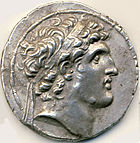
Silver coin of Alexander I "Balas". The Greek inscription reads ΒΑΣΙΛΕΩΣ ΑΛΕΧΑΝΔΡΟΥ (king Alexander). The date ΓΞΡ is year 163 of the Seleucid era, corresponding to 150–149 BC.
Demetrius Soter's son Demetrius II profited by the opportunity to regain the throne. Ptolemy Philometor, who was Alexander's father-in-law, went over to his side, and Alexander was defeated in the battle of Antioch (145 BC) in Syria,[4] sometimes known as the battle of the Oenoparus.
He fled for refuge to a Nabataean prince, who murdered him and sent his head to Ptolemy Philometor, who had been mortally wounded in the engagement.[4]
See also[edit]

- List of Syrian monarchs
- Timeline of Syrian history
Notes[edit]
^ "Alexander I Balas". Livius.org..mw-parser-output cite.citation{font-style:inherit}.mw-parser-output .citation q{quotes:"""""""'""'"}.mw-parser-output .citation .cs1-lock-free a{background:url("//upload.wikimedia.org/wikipedia/commons/thumb/6/65/Lock-green.svg/9px-Lock-green.svg.png")no-repeat;background-position:right .1em center}.mw-parser-output .citation .cs1-lock-limited a,.mw-parser-output .citation .cs1-lock-registration a{background:url("//upload.wikimedia.org/wikipedia/commons/thumb/d/d6/Lock-gray-alt-2.svg/9px-Lock-gray-alt-2.svg.png")no-repeat;background-position:right .1em center}.mw-parser-output .citation .cs1-lock-subscription a{background:url("//upload.wikimedia.org/wikipedia/commons/thumb/a/aa/Lock-red-alt-2.svg/9px-Lock-red-alt-2.svg.png")no-repeat;background-position:right .1em center}.mw-parser-output .cs1-subscription,.mw-parser-output .cs1-registration{color:#555}.mw-parser-output .cs1-subscription span,.mw-parser-output .cs1-registration span{border-bottom:1px dotted;cursor:help}.mw-parser-output .cs1-ws-icon a{background:url("//upload.wikimedia.org/wikipedia/commons/thumb/4/4c/Wikisource-logo.svg/12px-Wikisource-logo.svg.png")no-repeat;background-position:right .1em center}.mw-parser-output code.cs1-code{color:inherit;background:inherit;border:inherit;padding:inherit}.mw-parser-output .cs1-hidden-error{display:none;font-size:100%}.mw-parser-output .cs1-visible-error{font-size:100%}.mw-parser-output .cs1-maint{display:none;color:#33aa33;margin-left:0.3em}.mw-parser-output .cs1-subscription,.mw-parser-output .cs1-registration,.mw-parser-output .cs1-format{font-size:95%}.mw-parser-output .cs1-kern-left,.mw-parser-output .cs1-kern-wl-left{padding-left:0.2em}.mw-parser-output .cs1-kern-right,.mw-parser-output .cs1-kern-wl-right{padding-right:0.2em}
^ Chisholm 1911.
^ Smith, Philip Peter (1867). "Alexander Balas". In William Smith. Dictionary of Greek and Roman Biography and Mythology. 1. Boston: Little, Brown and Company. pp. 114–115. Archived from the original on 2011-06-06.
^ abc One or more of the preceding sentences incorporates text from a publication now in the public domain: Chisholm, Hugh, ed. (1911). . Encyclopædia Britannica. 1 (11th ed.). Cambridge University Press. pp. 565–566.
 One or more of the preceding sentences incorporates text from a publication now in the public domain: Chisholm, Hugh, ed. (1911).
References[edit]
Maas, Anthony John (1907). . In Herbermann, Charles. Catholic Encyclopedia. 1. New York: Robert Appleton Company.
Mørkholm, Otto (1981). "Sculpture and Coins: the Portrait of Alexander Balas of Syria". Numismatica e Antichità Classiche. Industria Grafica Gaggini-Bizzozero. 10. ISSN 1420-1739. OCLC 715323965.
Further reading[edit]
1 Maccabees 10 ff.
Justin xxxv. 1 and 2
Josephus. Antiquities of the Jews. 13.2.1..
Appian, Syrian Wars (=Roman History book 11), 67
Polybius, The Histories xxxiii. 14.
External links[edit]
 | Wikimedia Commons has media related to Alexander I Balas. |
Alexander Balas, article in historical sourcebook by Mahlon H. Smith
Alexander Balas Seleucid dynasty Born: Unknown Died: 146 BC | ||
| Preceded by Demetrius I Soter | Seleucid King (King of Syria) 150–146 BC | Succeeded by Demetrius II Nicator or Antiochus VI Dionysus |
Authority control  |
|
|---|
Categories:
- 146 BC deaths
- 2nd-century BC Babylonian kings
- Seleucid rulers
- Ptolemaic dynasty
- 2nd-century BC rulers
- Kings of Syria


(window.RLQ=window.RLQ||).push(function(){mw.config.set({"wgPageParseReport":{"limitreport":{"cputime":"0.568","walltime":"0.832","ppvisitednodes":{"value":2770,"limit":1000000},"ppgeneratednodes":{"value":0,"limit":1500000},"postexpandincludesize":{"value":70890,"limit":2097152},"templateargumentsize":{"value":1912,"limit":2097152},"expansiondepth":{"value":16,"limit":40},"expensivefunctioncount":{"value":7,"limit":500},"unstrip-depth":{"value":1,"limit":20},"unstrip-size":{"value":15715,"limit":5000000},"entityaccesscount":{"value":3,"limit":400},"timingprofile":["100.00% 730.416 1 -total"," 22.07% 161.188 1 Template:Lang-grc"," 17.24% 125.892 1 Template:Reflist"," 15.50% 113.224 1 Template:Infobox_royalty"," 13.81% 100.872 1 Template:Commons_category"," 12.00% 87.629 1 Template:Infobox"," 11.71% 85.507 1 Template:Commons"," 11.34% 82.844 1 Template:Sister_project"," 10.13% 73.955 1 Template:Side_box"," 9.28% 67.808 1 Template:Cite_web"]},"scribunto":{"limitreport-timeusage":{"value":"0.322","limit":"10.000"},"limitreport-memusage":{"value":13752265,"limit":52428800}},"cachereport":{"origin":"mw1264","timestamp":"20190126155335","ttl":2073600,"transientcontent":false}}});});{"@context":"https://schema.org","@type":"Article","name":"Alexander Balas","url":"https://en.wikipedia.org/wiki/Alexander_Balas","sameAs":"http://www.wikidata.org/entity/Q297657","mainEntity":"http://www.wikidata.org/entity/Q297657","author":{"@type":"Organization","name":"Contributors to Wikimedia projects"},"publisher":{"@type":"Organization","name":"Wikimedia Foundation, Inc.","logo":{"@type":"ImageObject","url":"https://www.wikimedia.org/static/images/wmf-hor-googpub.png"}},"datePublished":"2001-08-22T05:03:13Z","dateModified":"2019-01-21T08:40:31Z","image":"https://upload.wikimedia.org/wikipedia/commons/f/fa/Alexander_I_Syria-Antiochia_face.jpg","headline":"Seleucid ruler"}(window.RLQ=window.RLQ||).push(function(){mw.config.set({"wgBackendResponseTime":119,"wgHostname":"mw1242"});});


